 EM: Databases/SQL: Databases
> Types
EM: Databases/SQL: Databases
> Types
Description
The  Databases Tables displays the list of defined database types and their properties, allowing users to view, configure, and manage type-specific settings such as formatting, storage behavior, and default values within the selected database.
Note: Selecting a database from Databases name list, opens its configuration interface, and enabling access to Types .
Location
EM Navigator →  Databases/SQL → Databases → Types
Toolbar
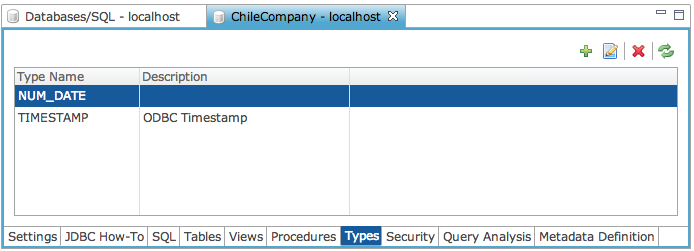
Types: Column Settings
Displays defined database types with names and descriptions, enabling selection and management of type configurations.
Column Settings
| Settings |
Description |
| Type Name |
Name
of the type definition. The data dictionary stores this name for
column type when a column uses a type definition. |
| Description |
The defined description of each database type, providing additional context or usage details. |
Creating New Type
Opens a form after clicking the  icon to create a new database type, allowing configuration of General properties such as name, base type, formatting, and default values, while the Legacy section contains deprecated fields not used by the SQL engine.
General Settings
Provides configuration fields for defining a database type, including name, processing behavior, formatting options, base type, and default values.
Note: Only three of the fields on this dialog are used by the SQL engine.
The remaining fields are legacy items no longer used by BBj, but left
in place for those developers who rely on information stored in these
fields. This documentation only addresses those fields recognized by BBj.
General Settings
| Settings |
Description |
| Type Name |
Name
of the type definition. The data dictionary stores this name for
column type when a column uses a type definition. |
| Description |
Description for the content of the type. |
| Value Processor |
Value processor to use for encoding/ decoding the data in a field value stored in a record.
| Value |
Description |
| Boolean Y/N Processor |
Available value processing options, allowing selection of a processor (e.g., Boolean Y/N) to control how data values are interpreted and handled. |
|
| Data Format |
Date format to be used when evaluating the type definition.
| Value |
Description |
| ADP |
Formats date values using ADP-specific numeric date representation. |
| AON |
Formats date values using AON-specific numeric date representation. |
| AON3_CYYMMDD |
Formats date values using AON3 structure with century, year, month, and day sequence. |
| CITI |
Formats date values using Citi-specific date representation format. |
| CYYMMDD |
Formats date values as century, year, month, and day in numeric sequence. |
| CalendarWeek |
Formats date values based on calendar week numbering. |
| DIAMOND |
Formats date values using Diamond-specific date representation. |
| DISC |
Formats date values using DISC-specific date format. |
| DayMonthYear |
Formats date values in day, month, and year order. |
| Julian |
Formats date values using Julian date representation. |
| Julian_Time |
Formats date values including Julian date with time component. |
| Julian_Time_Zero_As_Null |
Formats Julian date and time values, treating zero values as null. |
| Julian_Zero_As_Null |
Formats Julian date values, treating zero values as null. |
| MAI |
Formats date values using MAI-specific date format. |
| MAI_2K |
Formats date values using MAI format with year 2000 compliance. |
| Millisecond |
Formats date values including millisecond precision. |
| MonthDayYear |
Formats date values in month, day, and year order. |
| PBS |
Formats date values using PBS-specific date format. |
| SOA |
Formats date values using SOA-specific representation. |
| SQLDate |
Formats date values using standard SQL date format. |
| SSI |
Formats date values using SSI-specific format. |
| SSIJ |
Formats date values using SSI Julian-based format. |
| Timestamp |
Formats date values including full timestamp with date and time. |
| YMD8 |
Formats date values as an 8-digit year, month, and day sequence. |
|
| Base Type |
The base BBx/BBj
data type for this definition. These types correspond to BBx/BBj
template data types such as N, C, I, B, etc.
| Value |
Description |
| Business Math |
Stores values using BBj business math format for precise decimal arithmetic operations. |
| Character |
Stores values as character strings without numeric interpretation. |
| BCD |
Stores numeric values using binary-coded decimal format for exact precision. |
| IEEE Float |
Stores values using IEEE floating-point representation for approximate numeric calculations. |
| Integer |
Stores whole numeric values without fractional components. |
| Numeric |
Stores numeric values with support for precision and scale. |
| Binary Large Object |
Stores large binary data such as files or unstructured content. |
| Insigned Integer |
Stores non-negative whole numeric values without sign. |
| Resident Float |
Stores floating-point values using system-native floating-point representation. |
| Resident as Double |
Stores double-precision floating-point values using system-native representation. |
| Character As Binary |
Stores character data as binary values without character encoding interpretation. |
|
| Fully Optimize NUMERIC |
-
When unchecked, numeric values are not optimized using this type definition.
-
When checked, enables full optimization for numeric values using this type definition.
|
| Dictionary Length |
The length of
the field definition for the raw data in the record. This
may be different than the precision |
| Precision |
SQL precision for this type that will be returned to JDBC and ODBC applications. This is the total number of digits allowed in a value including those digit before and after the decimal point.
|
| Scale |
The total number
of digits after the decimal point. A number 123.45 would
have a precision of 5 and a scale of 2. |
| Default Value |
Default value for this type. If none is specified, null will be used when applicable. |
Legacy(not honored by SQL engine)
Note: The fields in this section are ignored by the SQL engine and only left in place for legacy purposes. Some applications have values stored in these fields and interpret those values on an application-specific basis.
See Also
BBjAdminBase
Databases
JDBC How-To
Tables
Procedures
Views
Security
Query Analysis
Permissions
Connection Pools
SQL/SELECT Connections
Table Analysis Queue
Index Builders


