 EM: BBjServices > Event Handlers
Description
In BBj 16.11 and higher, BBjServices  Event Handlers allows administrators to manage and automate system event responses using configurable BBj programs and email notifications. Handles events related to replication issues, memory conditions, and process activity. Provides options to define notification settings, select an email service, and assign a BBj program to respond automatically. Enables proactive monitoring and maintenance of BBjServices stability through customizable event-driven actions.
Location
EM Navigator →  BBjServices → Event Handlers
Toolbar
| Button | Function |
|---|---|

|
Refreshes the displayed Event Handlers. |
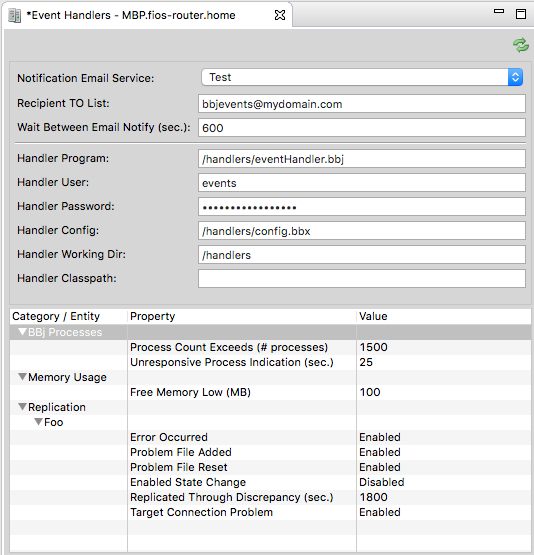
Event Handlers Settings List
| Settings | Description |
|---|---|
|
Uses the configured Email Service (from the Email Services node) to send Event Handlers notifications. |
|
|
List of comma separated email addresses to notify when an enabled event occurs. |
|
|
Specifies the time interval (default is 600 seconds) that the system waits before sending another notification of the same event type, preventing excessive email alerts during frequent event occurrences. |
|
|
Fully qualified filesystem path to the BBj program the Event Handlers service executes when an enabled event fires; the program must be reachable by BBjServices on the host. |
|
|
User account under which the handler program executes when an enabled event occurs, determining the permissions and environment used for the handler run. |
|
|
Password for the user if a user is specified and if a password is required. |
|
|
Full path to the config.bbx file to use when running the handler program. |
|
|
Full path to the working directory when running the handler program. |
|
|
BBj-specific classpath name to use when running the handler program. |
Event Handlers: Column Settings
Lists all available event categories and their corresponding properties, values, and descriptions, enabling configuration of monitored entities such as replication, licensing, memory usage, and BBj process events.
Event Handlers: Column Settings List
| Column | Description |
|---|---|
|
Groups event sources (e.g., processes, replication, licensing, disk, memory) to scope which events you’re configuring. |
|
|
Names the specific condition within the selected category that can trigger a handler. |
|
|
Sets the numeric or text parameter used by that property as the trigger threshold/setting. |
|
|
Explains what the property does and how its value influences the event trigger. |
Category/ Entity: Types of Events
Events are grouped together under categories. When the system triggers an event, it sends an email notification to the recipients (if configured) and/or executes the BBj handler program. Email messages contain information relevant to the type of event being reported.
Types of Events List
| Events | Description | ||||||||
|---|---|---|---|---|---|---|---|---|---|
|
Handles event notifications initiated independently of standard processes, allowing real-time asynchronous system monitoring responses. See: Asynchronous Triggers. |
|||||||||
|
Monitors running BBj processes for performance, responsiveness, and status to trigger event-based administrative notifications accurately. See: Processes.
|
|||||||||
|
Triggers a notification or handler action when available disk space falls below the specified gigabyte threshold to prevent storage-related issues. 0 indicates disabled.
|
|||||||||
|
Manages license-related event monitoring, including checkout failures, low available license counts, and license expiration alerts. Enables proactive notification or automated response when licensing issues occur. See: Licensing.
|
|||||||||
|
Monitors JVM free memory thresholds and triggers notifications or handlers when available memory drops below.
|
|||||||||
|
Triggers notifications or handler programs when replication issues occur, such as errors, problem files, state changes, or synchronization discrepancies between replicated systems. See: Replication |