 EM: File System > File Manager
Overview
The  File Manager panel lets administrators browse, inspect, and manage server-side directories and files connected to BBjServices directly from the Enterprise Manager. It provides a familiar two-pane directory browser alongside a rich set of file operations, from simple renaming and deletion to in-place file-type conversion and the creation of Online Copy Jobs.
Location
EM Navigator →  File System → File Manager
Toolbar


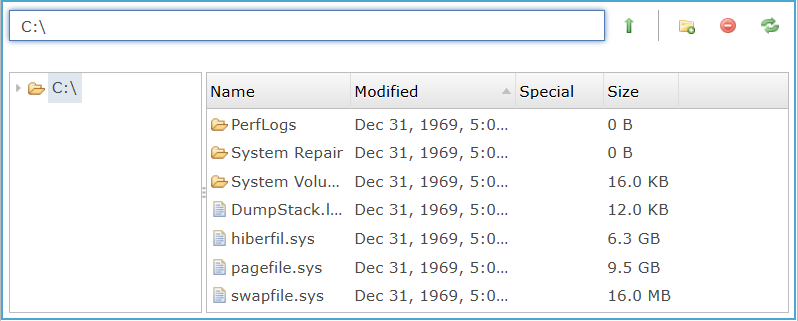
File Manager Panel
The File Manager presents a two-pane layout. A collapsible directory tree on the left lets you navigate the server's folder hierarchy. The file list on the right displays the contents of the selected directory. The current path is always shown in the path bar at the top of the panel.
File Manager Panel: Settings List
File Type Icons
Every file in the list is prefixed with a small icon that identifies its BBj file type at a glance.
Note: [SCREENSHOT, file list showing examples of each file type icon — M (MKEYED), X (XKEYED), V (VKEYED), S (SERIAL), lightning bolt (FULLTEXT), and generic page icon (STRING)].
File Type Icons List
| Icon | File Type | Description |
|---|---|---|
| M | MKEYED | Mkeyed data files are the legacy file type used for storing data providing up to 16 keys. |
| X | XKEYED | Xkeyed data files are a modern version of Mkeyed files that do not have the same constraints on key size or the number of keys on the file. |
| V | VKEYED | Vkeyed data files work in the same way as Mkeyed and Xkeyed but the record size is variable length making them particularly suitable for files containing potentially large values such as encoded binary data or long text. |
| E | ESQL | Exclusive SQL file only accessible using SQL operations. |

|
FULLTEXT | A Lucene full-text search index associated with a BBj data file. These files share the base name of the parent file with a .textsearch extension (for example, CUSTOMER.textsearch is the Lucene index for the CUSTOMER data file). |
 |
STRING (non-BBj) | A non-BBj file — text files, PDFs, images, binaries, configuration files, or any other file not natively managed by the BBj runtime. |
Context Menu
Right-clicking any file or directory in the file list opens a context menu with the following actions:
Context Menu Settings
| Settings | Description |
|---|---|
| Get Info | Opens the File/Directory Information dialog with detailed metadata about the selected item. See Get Info below. |
| Rename | Prompts for a new name for the selected file or directory. |
| Delete | Permanently deletes the selected file or directory after confirmation. |
| Convert | Converts the selected BBj data file to a different file type (MKEYED, XKEYED, or VKEYED) using an Online Copy Job. See Convert below. |
| Create Online Copy Job | Initiates a new Online Copy Jobs for this file, with control over the destination server, directory, filename, keys/indexes, record size, record layout, and target file type. See Create Online Copy Job below. |
Get Info
Selecting Get Info from the context menu opens the File/Directory Information dialog. The fields displayed differ depending on whether the selected item is a file or a directory.
File Information
When a BBj data file is selected, the dialog shows the following fields:
File Information Settings
Directory Information
When a directory is selected, the dialog summarizes the contents of the immediate folder. By default only the top-level directory is tallied. Click the Directory Size link inside the dialog to recalculate the total including all subdirectories.
Directory Information Settings
Convert
The Convert action changes the physical file type of an existing BBj data file — for example, converting an MKEYED file to VKEYED or XKEYED. Because the file may be open and actively used by running programs, the conversion is performed through an Online Copy Job, ensuring data integrity without requiring a maintenance window.
Note: To convert a file to ESQL, use the database editor instead. ESQL files are tied to a specific database configuration and cannot be created through the File Manager conversion workflow.
File Type Chooser Dialog
Selecting Convert opens the File Type Chooser dialog:
File Type Chooser Dialog Setting
| Setting | Description |
|---|---|
| Target Type |
The desired output file type. Available options are:
|
Clicking OK creates an Online Copy Job and immediately starts the conversion. A Conversion Started confirmation dialog appears and directs you to the Online Copy Jobs page to monitor progress.
Note: The Convert action only changes the file type. If you also need to change key structure, record size, destination directory, column mapping, or other advanced properties, use Create Online Copy Job instead, which provides full control over all of those settings.
Create Online Copy Job
Create Online Copy Job launches a guided workflow to copy a BBj data file to a new location — optionally with a type conversion or structural changes — while the source file remains fully accessible to running applications. This is the recommended approach when you need to:
-
Back up a live data file to another directory without downtime.
-
Restructure a file's key definitions, record size, or column mapping.
-
Copy a file to a different format and directory in one operation.
-
Rate-limit the copy operation to minimize impact on a production system.
For full documentation on Online Copy Jobs — including all job settings, monitoring, and management — see the Online Copy Jobs page.
Step 1 — Destination Information
The first dialog prompts for where the copied file should be written and whether it should receive a new file extension.
Step 2 — File Type Chooser
After specifying the destination, the File Type Chooser dialog appears. Select a target file type or choose < No Type Conversion > to copy the file to its destination without changing its format. The available options are the same as those described in the Convert section above.
Step 3 — Update the Online Copy Job
Clicking OK creates the job and opens the Online Copy Job editor allowing you to make additional changes to the copy job if needed.
Navigate to EM Navigator → File System → Online Copy Jobs to monitor job progress, abort a running job, or finalize synchronization once the copy is complete.
Monitoring Convert / Create Online Copy Job Operations
The Online Copy Jobs panel lists all active and recently completed jobs. Each job appears as an expandable row showing its auto-generated name and the individual files included. The Progress column updates in real time. The Selected Item Status area at the bottom of the panel shows real-time status messages for the currently selected job or file.
Online Copy Jobs keep the target file in sync with the source file as long as the job is running. Once a job reaches 100% in the progress column, the job can be “Finished.” Finishing a job completes the online copy job and no longer keeps the two files in sync. If a copy job is run while the file is in use by a live system, you should only perform the finish operation once all file access has stopped to ensure the copy matches the source. This is especially important when converting a file to a new type to ensure the new file has all changes.