Attaching to a Data Source
After the configuration file has been created, follow the steps listed below to connect to a data source:
If you have a config.TPM file, you are ready to connect to a data source. If you do not have a config.TPM file, please read the BASIS Data Dictionary section and follow these steps:
-
In the Windows Control Panel, double-click the 32-bit ODBC Administrator. (This was automatically installed when the BASIS ODBC Driver was installed.)
-
Click Add.
-
Select BASIS ODBC Driver 32-Bit, then click OK to display the BASIS ODBC Driver Data Source Configuration dialog. (Each field is described under Data Source Configuration Dialog Fields.)
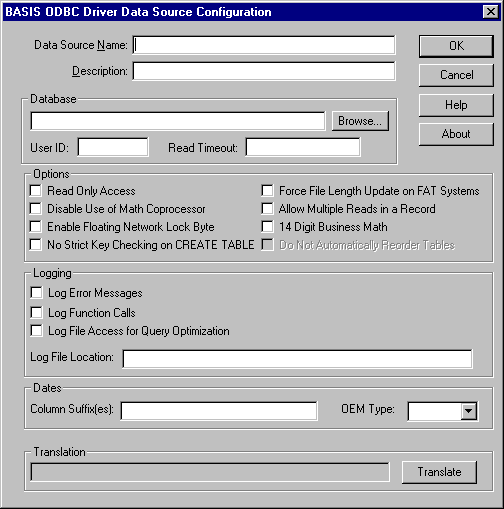
-
Click OK to accept the configuration, click Close to close the BASIS ODBC Driver Data Source Configuration dialog, then click OK again to exit the application.
Data Source Configuration Dialog Fields
Data Source Name
Enter a name for the data source.
Description
Enter a description of the data source.
Database
Enter the path and filename for the BASIS configuration file. The default filename is config.tpm. To search for the file, click the [Browse…] button.
-
The BASIS configuration file must contain at least two global strings: DICTIONARY and DATA:
-
The DICTIONARY value must point to the physical location of the BASIS data dictionary files. To resolve the location of the file paths defined in the dictionary, it is often necessary to establish a global path. If the data dictionary uses global strings (i.e., literals enclosed in parentheses) to define file paths, then these global strings must be defined in this configuration file.
-
The DATA value must point to the physical location of the data files for the data described in the data dictionary resides.
User ID
Enter the network user ID to be used to enable the client capabilities of the BASIS ODBC Driver so that it can communicate with a PRO/5 Data Server (registry keyword: userid).
Without a network user ID, you will be unable to connect to the PRO/5 Data Server.
Read Timeout
Enter an integer between 0 and 255 to indicate the number of seconds to wait for a locked record to become accessible for use. This corresponds to the TIM= option on a PRO/5 READ Statement. If left blank, the default of 10 seconds is applied.
Read Only Access
Checking this box prompts the BASIS SQL Engine to perform in READ_ONLY mode and prevents modifications to the data. Therefore, the SQL operations INSERT, UPDATE, DELETE, CREATE TABLE, and DROP TABLE will not be allowed (registry keyword: read_only).
Disable Use of Math Coprocessor
Selecting this option in the BASIS ODBC Driver Data Source Configuration dialog disables the math coprocessor. On machines with math coprocessors, the BASIS ODBC Driver may be able to use the coprocessor to enhance the speed and accuracy of the transcendental functions. Results can vary depending on the coprocessor in use. Select this option when running applications that require the results of these functions to be exactly the same (registry keyword: mathco).
Enable Floating Network Lock Byte
Checking this box enables the older, slower file-locking scheme. It allows standard access across the network (registry keyword: netlock).
No Strict Key Checking on CREATE TABLE
Checking this box, if no primary key is specified, causes a primary key to be created using as many columns as can be fit into the 120-character maximum key length restriction. If this option is not selected, the user must explicitly specify a primary key when creating a table or an error will occur.
For example:
|
Force File Length Update on FAT Filesystems
Checking this box forces MS-DOS to update the length of a dynamic file after any growth in the file (registry keyword: forceupdate).
Allow Multiple Reads in a Record
Checking this box allows multiple read processes to access the key region of a keyed file, while blocking write processes. There is a possibility that a system might perform enough read operations that a write operation would never gain exclusive access to the file (registry keyword: multireads).
14 Digit Business Math
Checking this box puts the ODBC Driver in a 14-digit Business Math mode. It forces templates and keys to use 14-digit Business Math precision and is included for compatibility with older BASIS products (registry keyword: bus14).
Log Error Messages
Checking this box causes the error messages generated by the BASIS SQL Engine to be written to the log file defined in Log File Location.
Log Function Calls
Checking this box causes each call to an ODBC API function to be written to the log file defined in Log File Location.
Log File Access for Query Optimization
Checking this box causes each filesystem read to be logged in the log file defined in Log File Location.
Log File Location
Enter a filename and path for the log file used by the BASIS SQL Engine to log the entries for the Log Error Messages, Log Function Calls, and Log File Access for Query Optimization boxes are checked.
Since the logging capability slows down execution, select only the necessary options (registry keyword: logfile).
Column Suffix(es)
Enter the suffix(es) of one or more columns that are to be converted to the OEM date type selected in the OEM Type list box. To apply the conversion to two or more columns, separate each with a comma.
OEM Type
Select the OEM date type for character columns whose names end in the column suffix. See OEM Date Type for the available types.
Translation
Clicking the [Translate] button displays the Select Translator dialog, providing the capability to select the Microsoft Code Page Translator or other ODBC character translator. The name of the selected translator appears in the Translation field.